Porsche Design
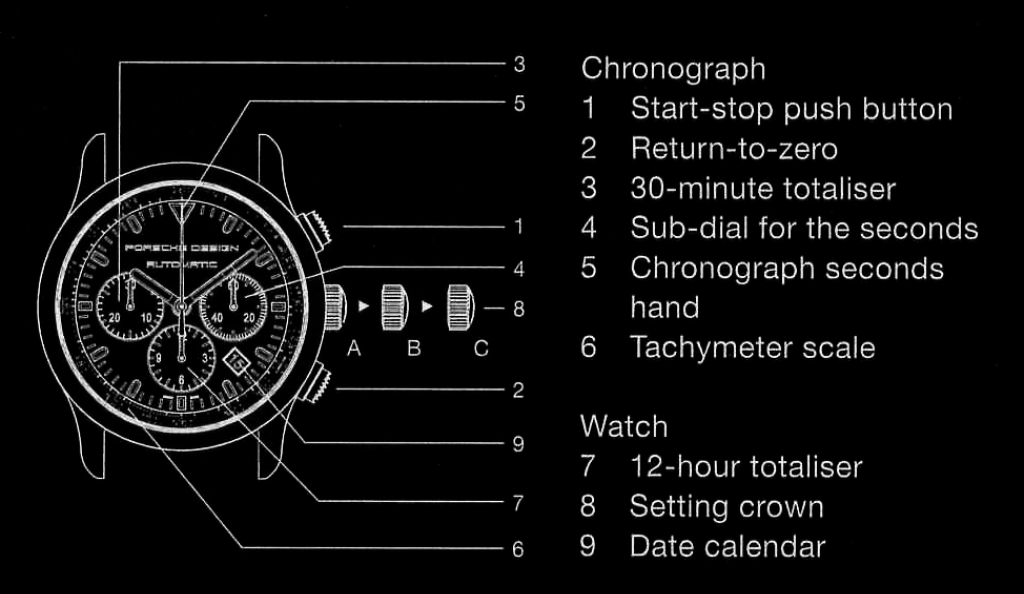
1. Watch functions
Your chronograph is fitted with a self-winding mechanical movement which combines the finest precision with proven reliability.
2. Setting the time and adjusting the calendar
2.1. Minutes hand
Release the crown [8] through several turns in the counterclockwise direction. Then pull it out two notches to position [C]. The seconds hand [4] will stop instantly. While the seconds hand is stationary, the hour and minute hands can be set to the correct time; push the crown back in and the hand on the seconds sub-dial [4] will start again. Then screw the crown [8] back down fully.
2.2. Adjusting the calendar
Unscrew the crown [8] as described on page 17. Pull it out one notch to position [B]. Then turn the crown until the correct date appears in the calendar window on the dial [9]. Push the crown in again and screw down. Remember to make sure that the date advances at midnight and not at noon. All corrections and settings may be made by rotating the crown counter-clockwise. Please also note that the date calendar should never be advanced manually, i.e. by rotating the crown, between 9 p.m. and 3 a.m.
Chronograph functions
The chronograph is designed for timing, recording and displaying on the dial time spans lasting up to 12 hours.
3. Starting the chronograph
When the push button [1] is pressed, the central chronograph seconds hand [5] starts. It makes one full turn of the dial in 60 seconds. The chronograph minute totaliser [3] records the time, which has elapsed since the start for up to 30 minutes. The 12-hour totaliser [7] records the number of hours [up to 12] since the start.
4. Stopping the chronograph
Further pressure on the push button [1] stops the [chrono] seconds hand; the elapsed time can be read.
5. Resetting the chronograph to zero
The chronograph is reset to zero by pressing push button [2], after which it is ready to begin a new timing operation.
6. Successive timing operations
To record and read a succession of separate timing operations, simply start and stop the chronograph at will by actioning push button [1]. The chronograph hands do not return to zero but directly resume their advance from their stopped position.
7. Tachymeter scale
The chronograph bezel features a tachymeter scale [6]. In tandem with the chronograph mechanism, it allows you to determine the average speed of a moving object. The tachymeter scale must first be calibrated over a predetermined distance —- one kilometre for instance. To measure the average speed of, say, one’s own car, the vehicle must cover precisely the prescribed distance. Press the push button [1] at the exact instant the vehicle passes the starting marker — a roadside milestone for example. When it reaches the finish marker, stop the chronograph by pressing the push button [1] again. The vehicle’s average speed can now be read on the tachymeter scale [6] opposite the tip of the chronograph centre seconds hand [5]. Reset the chronograph to zero by pressing the push button [2].
Important Recommendations
8. Wearing your watch on, in or near water
Your chronograph is water-resistant to a depth of 100 m [about 330 feet] thanks to its screw-locked setting crown and screwed-in case back. It should, however, never be forgotten that the watch’s rated water resistance was determined under test conditions and at a given moment in time and simply cannot imply any lifetime endurance guarantee. Normal day-to-day handling, the aging process affecting its water-resistance gaskets as well as temperature extremes [plunging the watch into cold water after an extended spell under the summer sun] are enough to compromise the technical integrity of any watch case. Water or even moisture inside the case can result in costly repair work. It is therefore advisable to bring the watch in regularly for a water-resistance check.
9. Looking after your chronograph
Your new chronograph is a precision instrument designed and built to exacting quality standards. The following advice is designed to help you preserve your watch’s precision timekeeping and to keep it in mint condition over the years. Remember to clean the watch regularly in lukewarm tap water. Never forget to rinse your watch thoroughly in fresh water after its every exposure to seawater.
10. Servicing and maintenance
Your chronograph should undergo a water-resistance check every year to avoid unpleasant surprises [the movement should be serviced every 3 to 4 years]. Should you have further questions regarding the chronograph, contact your official Porsche Design dealer or the general agent for your country.